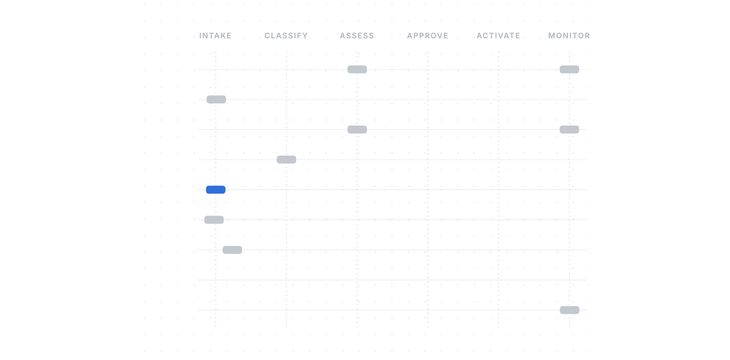
TPRM Lifecycle
Every third-party arrangement on one governed path, from draft contract to exit, proportionate to its risk.
One platform for every third-party arrangement, from contract intake and criticality to incidents, concentration and the Register of Information. Grounded in DORA, the Bank of Greece outsourcing framework (ΠΕΕ 178) and EBA/GL/2026/09. Runs inside your perimeter.
Every third-party arrangement on one governed path, from draft contract to exit, proportionate to its risk.

AI that does the reading, rules that do the checking, and people who decide.
Institutions must manage risk across all third-party arrangements, with outsourcing as one category within them.
Every third-party arrangement sits in one register. The outsourcing test classifies it rather than deciding whether you see it, and arrangements that are not outsourcing follow a proportionate workflow.
Critical or important outsourcing must be identified against defined criteria and notified to the Bank of Greece at least 60 calendar days before the contract is signed.
The platform assesses the regulatory criteria and a named officer records the decision and its rationale. The 60-day notice is counted to signature, including when an existing function becomes critical.
Contracts for critical or important functions must contain the mandatory clauses, from audit and access rights to termination and exit.
AI reads the contract and shows each clause with the passage it came from. A missing clause raises a finding citing the exact requirement; the verdict stays with your team.
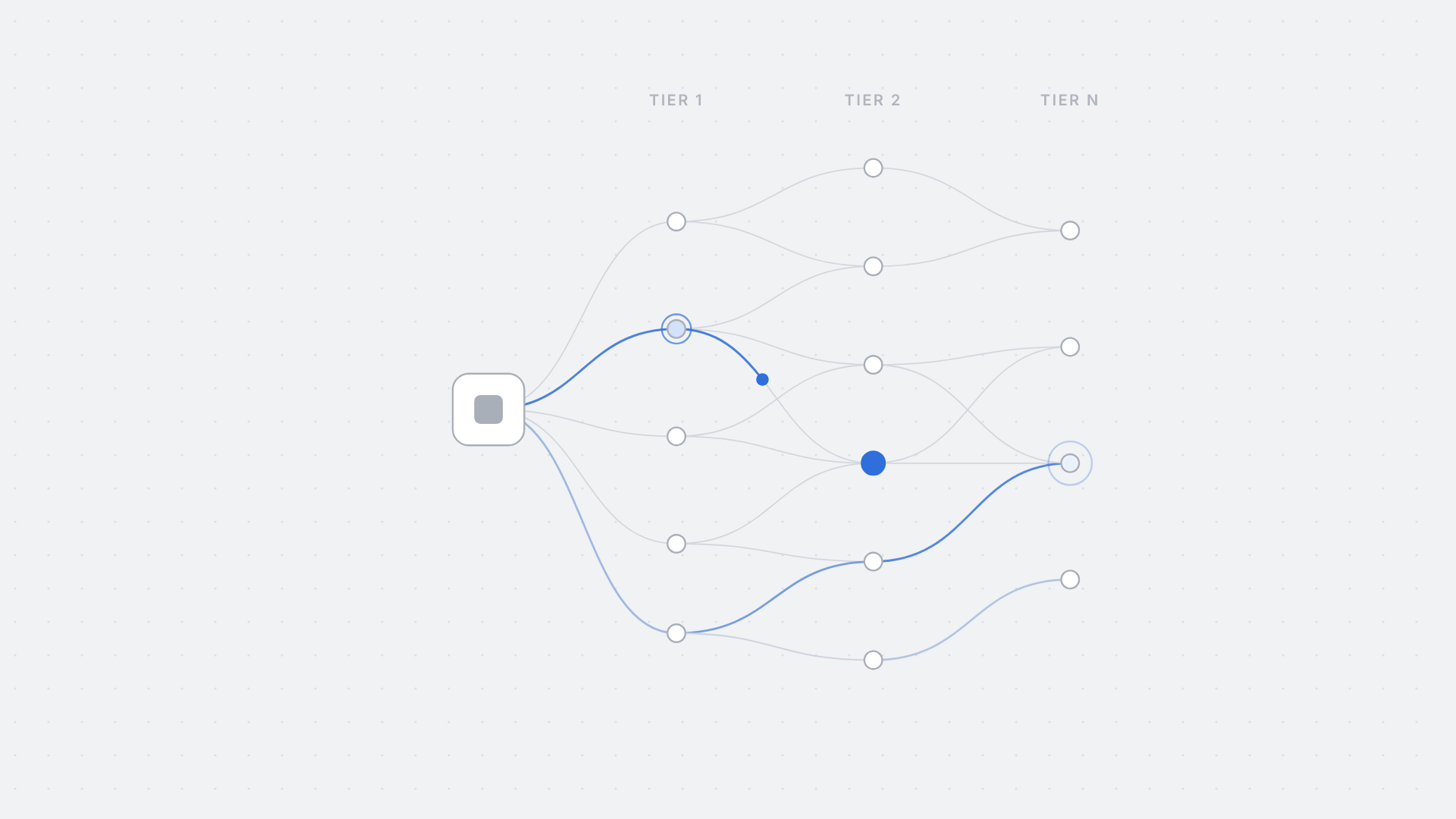
Institutions must assess concentration risk and know the subcontractors behind each critical service.
Concentration is flagged by provider and arrangement. The subcontracting chain is recorded link by link, with location, non-EEA processing and subcontractors shared across arrangements.
Major ICT incidents must be classified against regulatory criteria and reported within fixed deadlines.
Incidents are assessed against Delegated Regulation 2024/1772 and confirmed by a named officer. The initial, intermediate and final deadlines of Delegated Regulation 2025/301 are set and escalated.
Every contractual arrangement for ICT services must be in the Register of Information, at entity and consolidated level, in the supervisory format.
The Register of Information is kept from the same third-party register, validated for completeness and prepared as xBRL-CSV with EBA DPM codes. Your team files it.
Supervisors expect to reconstruct every decision: who took it, when, and on what basis.
Assessments, approvals and AI validations are dated and attributed, and each records the version of the regulatory rules that produced it.
Critical outsourcing follows the full regulatory path. Lower-risk third parties follow a lighter one. Depth follows risk, not paperwork.
Deployed inside your perimeter, on your infrastructure. AI runs on models your institution approves.
DORA, ΠΕΕ 178 and the EBA guidelines run as versioned rule packs maintained by INDEV. Regulatory change arrives as a release, not a customisation project.
Parent and subsidiaries in one platform, each under its own regime, with registers per entity and consolidated.
AI proposes; a named person decides, and every acceptance is recorded, in line with the human-oversight principle of the EU AI Act.
REST APIs, also available as Power Platform custom connectors, link the platform to your registers, identity and contract tools.
Talk to us about your institution's obligations.